
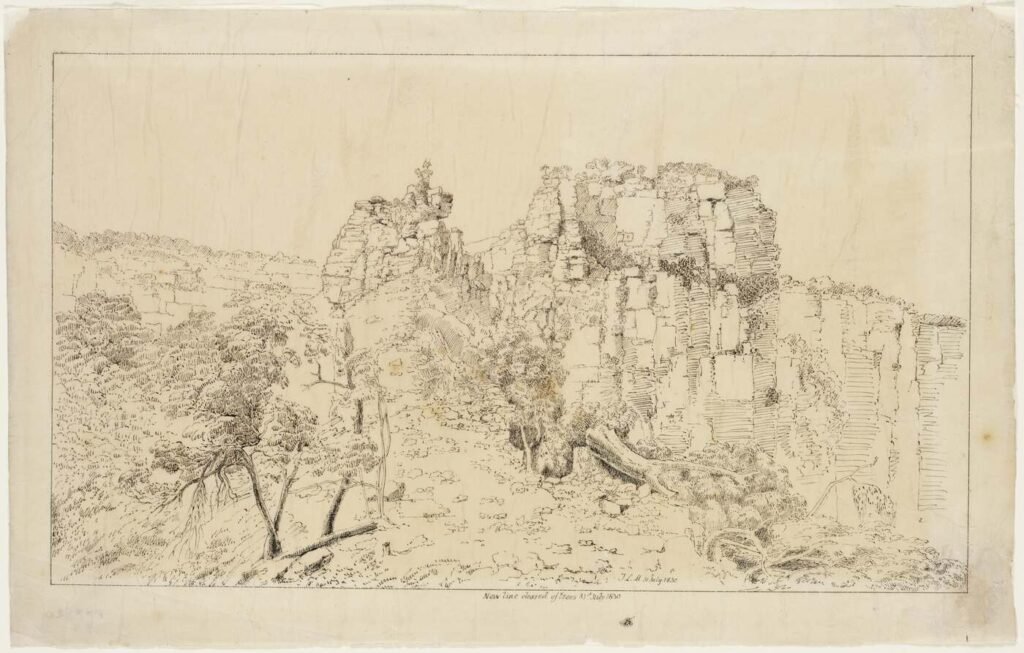
Lion’s Head, descent of Pass, July 1836 by Sir Thomas Mitchell.
Reproduced courtesy of the State Library of New South Wales (Dixson Library Collection).
As Victoria Pass falls quiet, we’re invited to look beyond the road, to the Blue Mountains colonial history that shaped her path. For nearly two centuries, the Victoria Pass Blue Mountains has carried travellers from the high sandstone plateau of the Blue Mountains, down into the wide-open landscapes of the west.
To understand Victoria Pass, we need to step back into the early colonial years, when the Blue Mountains were still a formidable barrier for the young colony of New South Wales.
In May 1813 the Three Explorers identified an exit from the Blue Mountains at Mount York, a mere 7 kilometres from present-day Victoria Pass Blue Mountains. Under the direction of William Cox, a convict-built road was formed in 1814; yet, its steep, narrow and often treacherous descent challenged all who travelled west. Bullock teams struggled, wagons overturned, with travel being slow and hazardous, on the steep 1-in-4 gradient.
As the colony expanded, movement between Sydney and the west increased, the need for a safer, more reliable descent from the Mountains became increasingly urgent.
By 1829, Surveyor General Thomas Livingstone Mitchell, was responsible for the survey of roads and bridges. Mitchell was a man with both ambition and an eye for the landscape, he saw opportunity where others saw obstacles. He identified an area, where a new road could be carved into the escarpment itself, he called this site Mount Victoria, after the young Princess Victoria (later Queen Victoria). Colonial records advise roadbuilding required “lowering of a narrow crest of rocks”, which was surveyors speak for “move this hill from here to fill in a chasm over here!”
Construction of Victoria Pass Blue Mountains began in 1830, utilising over 300 convicts, many assigned to road-gangs restrained by connected leg shackles. As one of the most significant convict built roads in NSW, they used basic tools such as picks, hammers, and chisels, painstakingly cutting into solid rock, removing vast quantities of sandstone by hand.
At the heart of the pass lies its most striking features: two narrow sandstone causeways. The causeways were constructed with stone retaining walls, supporting the road in places where the terrain dropped away sharply, drainage systems were added to prevent water damage, then causeways were backfilled with earth and rubble. Today, their craftsmanship is evident in the tight stonework, and the way they sit so confidently within the landscape and live as a testament to Blue Mountains colonial history.
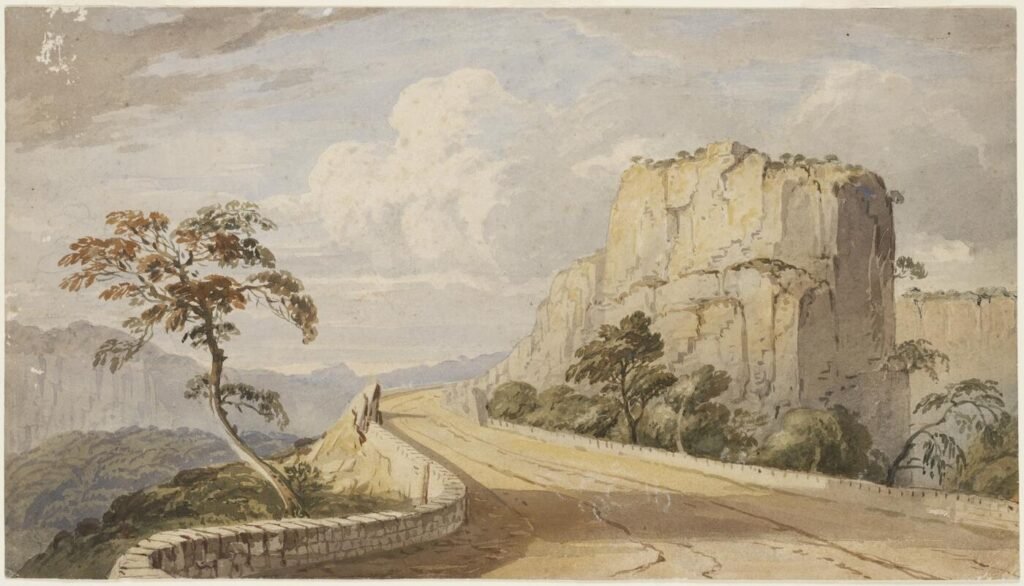
Early colonial engineering of convict built roads NSW Victoria Pass sandstone causeway construction.
Although early references occasionally used the term “Pass of Victoria,” the name was formally established as Victoria Pass from 1832. Officially opened by Governor Richard Bourke in October 1832, the Pass is acknowledged as one of the greatest engineering stories of the colonial era. Connecting Sydney with emerging settlements like Lithgow, Bathurst, and beyond; supporting the growth of agriculture, trade, and communication across the colony of New South Wales.
By the early 1900s,this section of convict built roads in NSW, built for carts and livestock, entered a new and noisy chapter, with the arrival of the motor car. Early motorists would approach the Victoria Pass Blue Mountains with apprehension; their vehicles straining, engines overheating, and with brakes were carefully managed, drivers frequently stopped to let both their machines and their nerves recover.
Early motor cars struggling on the steep ascent would sometimes be assisted by teams of horses or bullocks. Natural horsepower was often the only way to conquer the most punishing sections of the Pass, on the steep 1-in-8 gradient.
John Berghofer, President of the local Shire of Blaxland council, and regarded as the Father of Mt Victoria, championed the need for a new road, with a gentler gradient. Construction commenced in 1907, the new pass to the north of the Victoria Pass, opened in February 1912, becoming immediately popular, the road took on the name “Berghofer’s Pass”. This pass was officially closed to vehicle traffic in 1934, as motor cars became better suited to the gradients of Victoria Pass.
Listed on the National Trust Register (1988) and recognised on the New South Wales State Heritage Register (2024), Victoria Pass is more than infrastructure, it is among the oldest surviving convict built roads in NSW, and a living piece of Blue Mountains colonial history.
Its recent closure is a reminder of its age and the immense pressures placed upon it, a far cry from the horse-drawn wagons it was built for.
When Victoria Pass reopens, it will be a continuation of a journey that began nearly 200 years ago, carved into the mountain by hand, a story of a colony, striving to overcome the formidable barrier of the Blue Mountains.
Book a historical Tour Contact Mountains Tales to include a visit to view all Mt Victoria has to offer as part of your next Blue Mountains historical tour.